Saturday, January 31, 2026

Lemon Indictment Underscores Need to Recuse Judge Patrick Schlitz

 A grand jury in Minnesota has indicted former CNN anchor Don Lemon for allegedly participating in the storming of a church in St. Paul. This event has sparked criticism of Judge Patrick Schlitz, who is accused of bias in handling the case.

1. Indictment Details: Don Lemon and three others were charged for conspiracy against rights, violating the FACE Act, and intimidation during church services. Attorney General Pam Bondi confirmed the arrest, which occurred while Lemon was covering the Grammy Awards.

2. Judicial Bias Allegations: The chief judge, Patrick Schlitz, is criticized for his political bias, particularly his support for immigrant rights, which some argue could affect his impartiality in cases related to immigration enforcement and deportation efforts.

3. Legal Proceedings: There was a dispute between Judge Schlitz and the Department of Justice (DOJ) over charges against Lemon. Despite the DOJ presenting probable cause, Schlitz refused to reverse another judge's decision not to charge Lemon, leading to a grand jury proceeding that ultimately indicted him.

4. Political Involvement: Judge Schlitz has been linked to the Immigrant Law Center of Minnesota, a group associated with supporting immigrant rights. Critics argue that his donations to this organization compromise his neutrality in cases involving immigration law.

5. Controversial Statements: Schlitz has made various statements in court that some view as politically charged and lacking evidence. He accused ICE of violating numerous court orders and made claims about the legality and treatment of immigrants that critics believe misrepresent the facts.

The indictment of Don Lemon highlights not only issues of individual accountability but also raises serious concerns about the impartiality of judges involved in politically sensitive cases. Calls for Judge Schlitz’s recusal and a review of his conduct have been made to address these concerns and uphold the integrity of the judicial system.

https://www.declassified.live/p/lemon-indictment-underscores-need

BLACK ROBE CORRUPTION: Michigan Judge and Three Co-Conspirators Accused of Looting Hundreds of Thousands from Incapacitated

Federal prosecutors have charged a sitting judge and three associates in a scandal involving the embezzlement of funds from incapacitated individuals in Michigan. The defendants are accused of misappropriating substantial amounts of money from those under their care, revealing serious misconduct within the judicial system.

• Defendants: The case involves four key figures:

• Judge Andrea Bradley-Baskin: A current judge on Michigan’s 36th District Court.

• Avery Bradley: An attorney and father to Judge Bradley-Baskin.

• Nancy Williams: The owner of Guardian and Associates, an agency managing the affairs of incapacitated individuals.

• Dwight Rashad: Operated group homes for elderly individuals needing care.

• Charges: The four have been indicted on various charges:

• Conspiracy to commit wire fraud.

• Multiple counts of money laundering.

• Judge Bradley-Baskin is additionally charged with making a false statement to federal investigators.

• Allegations: The indictment details various forms of financial abuse:

• $70,000: Allegedly used by Bradley-Baskin for an ownership stake in a bar, taken from funds meant for a ward.

• $203,000: Taken from a legal settlement for a ward, with none benefiting the ward.

• Rent payments: Williams allegedly made for wards who never lived in one of Rashad’s facilities.

• Luxury expenses: Bradley-Baskin reportedly used embezzled funds to lease a new vehicle for herself.

• Context: The indictment highlights a systematic abuse of the fiduciary duty by the defendants, who were trusted to act in the best interests of their wards. Under federal law, guardians and conservators must protect the personal and financial affairs of individuals deemed incapacitated.

• Response from Authorities: U. S. Attorney Gorgon emphasized the breach of public trust represented by these allegations, stating that no one is above the law. Investigative agencies, including the FBI, have committed to prosecuting those who exploit vulnerable populations for personal gain.

The indictment against Judge Bradley-Baskin and her associates raises serious concerns about corruption within the Michigan judicial system, particularly regarding the protection of its most vulnerable citizens. The allegations of extensive financial misconduct highlight the urgent need for oversight and accountability within fiduciary responsibilities. Authorities have expressed their determination to bring justice for the victims affected by these actions. 

https://www.thegatewaypundit.com/2026/01/black-robe-corruption-michigan-judge-three-co-conspirators/

Russia's Lukoil To Sell Bulk Of International Portfolio To US Carlyle Group

Lukoil, Russia's second-largest oil producer, has agreed to sell a majority of its international assets to the Carlyle Group, a private equity firm, due to ongoing Western sanctions. This decision follows a significant economic penalty imposed on Russia amid the continuing conflict in Ukraine.

• The deal involves Lukoil's international assets, initially valued at $22 billion, but excludes its operations in Kazakhstan, which will remain under Lukoil's control.

• The sale is a direct response to Western sanctions, particularly those imposed during the Trump administration, aimed at pressuring Russia regarding its involvement in Ukraine.

• The agreement requires approval from the US Treasury’s Office of Foreign Assets Control (OFAC) and is still subject to multiple conditions.

• Lukoil expressed intentions to sell its international assets as early as October, acknowledging the impact of restrictive measures on its operations.

• After the announcement, other companies, including Chevron and ExxonMobil, showed interest in acquiring Lukoil's assets, notifying the US Treasury of their intentions.

• The ongoing negotiations with potential buyers indicate that Lukoil is exploring various options while the formal bidding process is underway.

The sale of Lukoil's international assets to the Carlyle Group marks a significant shift in the company’s operations due to external pressures from sanctions. With further negotiations ongoing and regulatory approvals required, the situation highlights the broader implications of geopolitical tensions on energy markets and corporate strategies. 

https://www.zerohedge.com/energy/russias-lukoil-sell-bulk-international-portfolio-us-carlyle-group

A Voter Fraud Reckoning in Georgia?

The FBI recently conducted a raid on Fulton County’s Election Hub and Operations Center, authorized by a sealed search warrant. This raid is part of an investigation into possible voter fraud related to the 2020 election, with mixed reactions from the media and local officials.

1. Search Warrant Details: The warrant allows the FBI to search for various election-related documents, including physical ballots from the 2020 General Election, tabulator tapes, and voter rolls. The FBI has already seized 700 boxes of such records.

2. Legal Basis for the Raid: The warrant suggests potential violations of laws regarding the retention of election records and offenses related to procuring false votes or registrations. The inquiry may hint at a ballot-harvesting scheme.

3. Concerns About Record Handling: Local Democratic officials expressed worries about the handling and chain of custody of the seized records. Concerns were raised over whether these documents could be manipulated after leaving county control.

4. Previous Audits Questioned: Critics have pointed out that earlier audits of the 2020 election results were merely count checks and did not include authentication measures, which are critical for legitimacy.

5. Reported Issues with Election Records: Various irregularities have been reported regarding ballots, such as unsupported early vote ballots, lack of signature reviews, and discrepancies in recorded timestamps on ballot images.

6. Trump's Reaction: Former President Trump has shown interest in the investigation, stating that people related to the 2020 election will face prosecution for any wrongdoing.

The FBI's raid in Fulton County marks a significant development in ongoing discussions about the integrity of the 2020 election. As investigations unfold, further scrutiny of election integrity practices continues, with implications for future electoral processes. 

https://www.americanthinker.com/articles/2026/01/a_voter_fraud_reckoning_in_georgia.html

Investigators Can’t Find Tapes Showing Fulton County’s 2020 Ballot Count Started At Zero, Board Says

A significant issue has emerged regarding the handling of election documents in Fulton County, Georgia, related to the 2020 presidential election. Recent meetings and investigations have revealed that critical "zero tapes," which confirm that ballot counts started at zero, may be missing. This has raised concerns about the integrity of the election process in a county that faced multiple challenges during the 2020 elections.

1. Missing Tapes: Members of the State Election Board (SEB) expressed alarm during a recent meeting when it was revealed that "zero tapes," necessary for verifying proper ballot counting, could not be located for the 2020 election.

2. Zero Tapes Function: A "zero tape" must be printed and signed before counting begins on a ballot scanner. This tape shows that the count started at zero, and it helps ensure no previous votes are counted. In December 2020, Fulton County officials admitted they failed to sign over 100 tabulator tapes, affecting the count of approximately 315,000 votes.

3. Board Concerns: SEB member Jan Johnston clarified that the zero tape is critical for ensuring the integrity of the election process, comparing it to a trip odometer that needs to be reset before starting a journey.

4. Lack of Documentation: Investigators struggled to find any of the 148 early voting "zero tapes," as there seems to be confusion about where these tapes should have been delivered post-election. Fulton County’s regulations do not clearly outline the process, leaving many questions unanswered.

5. State Investigation: Following a complaint by election integrity advocate David Cross in 2022, Secretary of State Brad Raffensperger’s office investigated and confirmed the absence of zero tapes from early voting. This led to further inquiries about their whereabouts.

6. FBI Involvement: A week after the SEB meeting, an FBI raid occurred at the Fulton County election office, focusing on retrieving the missing zero tapes from the 2020 election.

7. Unclear Outcomes: The SEB is left with many uncertainties about the zero tapes. It is unknown whether they were properly handled and later disposed of or if they are simply misplaced. There is currently no evidence of a paper trail to confirm their status.

The situation in Fulton County raises troubling questions about the security and administration of elections. Missing zero tapes present a significant concern for election integrity, emphasizing the need for better clarity and procedures regarding election documentation. Without proper accountability and tracking of crucial materials, there is a risk that trust in the electoral process could be further undermined. As investigations continue, it remains unclear what will happen next regarding the missing tapes and the overall oversight of Fulton County's election operations. 

https://thefederalist.com/2026/01/30/investigators-cant-find-tapes-showing-fulton-countys-2020-ballot-count-started-at-zero-board-says/

Panama boots China from Panama Canal in another victory for Trump’s Monroe Doctrine revival

Panama’s Supreme Court has recently ordered the removal of a Chinese company from the Panama Canal, which aligns with former President Donald Trump's efforts to reassert U. S. influence in Latin America and diminish China's presence in the region.

1. Supreme Court's Decision:

• The ruling by Panama's high court forces the ouster of a Chinese port operator from the strategically important Panama Canal.

• This decision supports Trump's Monroe Doctrine revival aimed at curbing China's influence in Latin America.

2. Historical Context:

• Trump highlighted that the Panama Canal was handed over to Panama but has leaned towards Chinese control, claiming that the U. S. is reclaiming it.

• In his inauguration speech, he emphasized that the canal should not be in Chinese hands.

3. Legal Conflict:

• This ruling follows a year-long legal struggle between the Chinese and Panamanian governments concerning the operations at the canal's ports.

• The Chinese government's regulators had blocked the Hong Kong-based CK Hutchinson shipping company from selling its port stakes to an American consortium, revealing tensions around control and ownership.

4. U. S. Response:

• U. S. officials, including Secretary of State Marco Rubio, have expressed approval of the court's decision, characterizing Chinese influence as a threat.

• The U. S. has pressured Panama to reject Chinese control over the canal, viewing it as vital for national security.

5. Chinese Influence in Latin America:

• In recent years, China has become a major trade partner and investor in Latin America, engaging in various infrastructure projects.

• China’s strategic relationships in the region, particularly with nations like Venezuela and Cuba, have raised concerns for the U. S.

6. Impact on Chinese Investments:

• The court ruling is a significant setback for China, who has sought to expand its influence in Panama and the wider region.

• The U. S. administration had already targeted Venezuela's Maduro, who was a close ally of Beijing, leading to further complications for Chinese investments.

7. Future Considerations:

• China's plans are hindered by the recent court ruling, and ongoing issues regarding U. S. sanctions and strategic pressures on Latin American nations pose challenges for Chinese investments and relationships.

• The dispute over CK Hutchison's contractual agreements reflects broader concerns about the economic interests tied to the canal.

The ruling by Panama's Supreme Court to remove Chinese control from the Panama Canal reflects a significant policy shift towards U. S. interests in the region, aligning with efforts to diminish China's growing influence. This decision, along with actions against China's relationships in Venezuela and elsewhere, suggests a proactive approach from the U. S. to secure its interests in Latin America through legal and diplomatic means. 

https://justthenews.com/government/diplomacy/panama-boots-china-panama-canal-another-victory-trumps-monroe-doctrine-revival

The War on Terror Came Home

In Drew T. Allen's article, he examines the current political climate in America, focusing on the left's treatment of various groups and the increasing intolerance towards dissent. Through his book, "For Christ and Country: The Martyrdom of Charlie Kirk," he reflects on the dangers of moral fanaticism and the potential decay of American society.

• The article discusses how the left perceives illegal immigrants as victims while criminalizing law enforcement, like ICE agents. A contradiction arises when the left calls for the defunding of ICE following a protest-related death but continues to support open border policies after violent crimes by illegal immigrants.

• Allen points out the left's focus on military support for foreign conflicts while mocking domestic concerns about security. This double standard raises questions about national priorities.

• The shift in political discourse is detailed, starting with Hillary Clinton's labeling of Trump supporters as "deplorables. " Disagreements are no longer seen as mere political differences but as moral failings, leading to public shaming and physical violence against political opponents.

• Incidents of violence against Republicans, such as assaults and assassination attempts, illustrate the extreme consequences of intolerant rhetoric.

• The author argues that the left's tactics echo those of radical jihadist groups, rejecting debate and promoting submission instead. Intimidation and violence are normalized, creating an atmosphere where political disagreement is equated with moral evil.

• Allen stresses that the recent murder of Charlie Kirk serves as a warning sign for America, indicating what occurs when a political movement prioritizes coercion over persuasion. He asserts that nations decay gradually when citizens become desensitized to intimidation and fear.

The article warns that unless decisive action is taken to address the current political climate, including rejecting intimidation and publicly naming these issues, America may face further decay. Allen's work emphasizes the importance of acknowledging and confronting the troubling trends within political discourse before they worsen. The choice to reverse course lies with the citizens. 

https://amgreatness.com/2026/01/31/the-war-on-terror-came-home/

The Radicalization of American Politics

American politics has become a form of entertainment driven by boredom and the desire for emotional engagement. It posits that people are turning to politics not out of deep ideological commitment, but as a substitute for more meaningful fulfillment in their lives.

1. Politics as Entertainment: Many Americans now consume politics like entertainment, seeking distraction from boredom rather than being engaged in serious discussions. This shift has led to political battles being fought for attention, rather than for ideas or logical reasoning.

2. Cultural Crisis: The author references Eric Hoffer's concept that mass movements are fueled by boredom and dissatisfaction rather than conviction. This reflects a deeper cultural void, as traditional sources of meaning such as community and religion have diminished.

3. The Impact of Media: Tools like TikTok and Instagram have shortened attention spans and created a need for constant engagement, further driving the politics-as-entertainment narrative.

4. Radicalization Across the Spectrum: Both the left and the right are portrayed as victims of this “Entertainment” addiction, with actions often justified by emotions rather than rationality. The article discusses episodes of violence and outrage justified in the name of political causes as symptoms of this addiction.

5. The Call for Truth: Figures like Ben Shapiro highlight the importance of truth amidst this chaotic landscape. The article suggests that genuine victory in politics cannot be achieved without a return to serious discourse.

The article ultimately warns against the dangers of political radicalism being glamorized as entertainment. It advocates for a return to serious political engagement characterized by truth and responsibility, arguing that American conservatism should embrace a more grounded and less sensational approach to political discourse. 

https://spectator.org/the-radicalization-of-american-politics/

The Myth of Easy Infrastructure

The construction of the Golden Gate Bridge is often celebrated as a remarkable achievement in public infrastructure. Completed in 1937, the bridge was built under budget and ahead of schedule, which has led many to view it as a testament to efficient public works. However, this perception overlooks the complex, lengthy political and regulatory processes that preceded its construction. This summary highlights key lessons from the bridge's development, emphasizing the balance between independence and accountability in public infrastructure projects.

1. Time and Planning Before Construction:

• The construction of the Golden Gate Bridge took only four and a half years, but the entire process, from initial designs to completion, spanned nearly 15 years due to political negotiations and legal hurdles.

• In 1919, the San Francisco Board of Supervisors tasked engineer Michael O’Shaughnessy with studying the feasibility of a bridge. O’Shaughnessy enlisted Joseph Strauss for the bridge design, which underwent several revisions based on public and expert feedback.

2. Formation of an Independent Governing District:

• To facilitate the bridge’s construction, an independent governing body was created following the passage of the Bridge and Highway District Act in 1923, allowing for multi-county collaboration.

• Despite its need for public input and voter approval, the governing district was unprecedented at the time, setting a model for future infrastructure projects.

3. Approval Challenges:

• The formation of the bridge district faced significant legal challenges, including over 2,300 court complaints and a two-year approval process.

• The political fight included opposition from steamship lines and even initial disapproval from O’Shaughnessy regarding the bridge’s design change. Despite these obstacles, the bond issue for construction was eventually approved.

4. The Role of Independent Management:

• The governance structure of the bridge allowed engineers significant control, which was vital for innovative design and swift construction decisions.

• Joseph Strauss, as chief engineer, managed contracts and oversaw engineering efforts, facilitated by flexible employment structures that attracted top talent.

5. Financial Structure and Accountability:

• The bridge was funded through tolls and bonds, which aligned financial incentives with project success. This motivated the team to complete the bridge on time and under budget.

• However, the independence of the governing district later led to financial issues, as the district began to overspend after the bridge's successful operation.

6. Long-Term Implications of Independence:

• After the bridge’s completion, its independent status led to rising operational costs and challenges related to accountability, mirroring issues seen in other infrastructure projects.

• Despite initial success, the district faced difficulties maintaining fiscal responsibility, which often led to indefinite tolls and expenditure on less efficient services.

The Golden Gate Bridge serves as a case study in the complexities of public infrastructure development. While its construction exemplified efficiency due to its independent governance and clear financial incentives, it also highlights challenges that arise from such independence, including potential accountability issues and long-term financial sustainability. Stakeholders in modern public works projects must balance the need for rapid construction against the essential oversight to ensure that infrastructure continues to meet public needs effectively. The history of the Golden Gate Bridge emphasizes the importance of aligning management incentives with public interests both during and after construction. 

https://www.city-journal.org/article/golden-gate-bridge-construction-infrastructure

Real Environmental Crisis Is Not Climate Change

 Vijay Jayaraj, argues that the real environmental crises facing the world, especially in developing countries, are not primarily related to climate change but rather to pollution, waste management, and land degradation. He believes that the focus on climate change detracts from addressing these pressing issues that affect people's health and well-being.

1. Misguided Focus: Jayaraj claims that while Western nations and elites emphasize climate change and carbon footprints, developing nations are grappling with immediate and severe environmental problems, such as water pollution and waste management issues.

2. Real Environmental Crisis: He cites the example of Ghana, where only a fraction of waste is collected, resulting in health risks from vector-borne diseases like malaria. In South African townships, diseases related to inadequate waste management are rampant.

3. Plastic Pollution: Southeast Asia is mentioned as a major contributor to marine plastic pollution due to poor waste management. The author asserts that this pollution stems from governance failures rather than climate change.

4. Fund Allocation Issues: Billions spent on renewable energy initiatives often leads to neglect of more urgent needs, such as improving infrastructure for waste management and sanitation in developing countries. He suggests that efforts to combat climate change divert necessary resources away from these essential services.

5. Doubt on Climate Models: Jayaraj challenges the prevailing belief that carbon dioxide (CO2) dramatically affects global temperatures. He argues that scientific claims about CO2 driving dangerous global warming are unscientific and outdated.

6. Past Climate Trends: He presents historical data indicating that global warming rates between 1899 and 1940 may have been higher than those observed since, raising questions about the current focus on human emissions as the main cause of climate change.

7. Infrastructure and Energy Needs: The author highlights the need for reliable energy sources like fossil fuels to address real environmental issues. He argues that clean technologies such as incinerators and recycling plants require reliable baseload power, which is currently best provided by coal and natural gas.

8. Quality of Life Concerns: For many people, particularly in poorer countries, the fight for clean water, air, and better sanitation is more pressing than concerns over carbon footprints or climate change.

9. Negative Global South Impact: Jayaraj warns that the continued focus on climate change issues, rather than immediate pollution and waste concerns, delays real environmental remediation needed by populations in the Global South.

The article presents a controversial viewpoint that prioritizing climate change over more pressing environmental issues leads to detrimental consequences for the health and well-being of communities in developing nations. Resources currently directed toward climate initiatives should be better allocated to address pollution, sanitation, and waste management challenges. The author calls for a shift in perspective to tackle these urgent and impactful environmental problems facing the Global South. 

https://wattsupwiththat.com/2026/01/30/real-environmental-crisis-is-not-climate-change/

Entrepreneurship Beyond Politics: Mises Circle in Oklahoma City

The Mises Institute is hosting an event in Oklahoma City titled Entrepreneurship Beyond Politics on February 21, 2026. The event will focus on the role of entrepreneurs in fostering prosperity in the face of perceived political dysfunction.

• Theme: The event emphasizes that entrepreneurs, not politicians, drive economic success and innovation.

• Featured Speakers:

• Dr. Keith Smith: Founder of the Oklahoma Surgery Center, advocates for direct-primary care which seeks to bypass the issues imposed by insurance systems.

• Caitlin Long: Advocate for Bitcoin and founder of Custodia Bank, actively challenging the Federal Reserve and seeking to create a banking alternative that serves customers rather than political interests.

• Additional insights will be shared by Ryan McMaken, Per Bylund, and Timothy Terrell.

• Schedule:

• Registration opens at 8:30 AM with breakfast provided.

• Various talks will occur throughout the day followed by adjournment at 12:30 PM.

• Registration Fees: The cost is $70 for Mises members and $85 for non-members, which includes breakfast and access to lectures.

• Sponsorship Opportunities: Donors can sponsor the event for $2,500 or $5,000 with corresponding benefits.

The Mises Circle aims to inspire discussions around entrepreneurship as a solution to governmental shortcomings, with a line-up of influential speakers set to share their experiences and insights. Participants will have opportunities to engage, network, and explore the significance of solutions to political challenges. 

https://mises.org/events/entrepreneurship-beyond-politics-mises-circle-oklahoma-city

Texas special congressional election this weekend between 2 Democrats will further reduce GOP's fragile control of House

A recent report from Fox News discusses the current political landscape, focusing on the upcoming special elections, particularly in Texas, and the implications they have on the Republican majority in the House of Representatives.

1. Fragile Republican Majority: The Republican Party holds a slim majority in the House of Representatives with 218 members against 213 Democrats. This majority is threatened by upcoming special elections.

2. Texas Special Election: There is a special election scheduled in Texas' 18th Congressional District, previously held by Democratic Rep. Sylvester Turner, who passed away in March 2025. The two candidates are both Democrats: Christian Menefee and Amanda Edwards.

3. Anticipated Outcomes: The winner of the Texas special election will increase the Democratic presence in the House, making it harder for Republicans to maintain control. House Speaker Mike Johnson has expressed concern over the safety and attendance of Republican members in Congress.

4. Other Special Elections: There are additional special elections scheduled in New Jersey and Georgia:

• New Jersey: A primary election for a seat vacated by former Rep. Mikie Sherrill, with a Democratic primary on February 5.

• Georgia: A special election to fill the seat left by former Rep. Marjorie Taylor Greene, with a large pool of candidates expected, necessitating a potential runoff election.

5. Impact of Redistricting: The special elections are occurring under current congressional district lines, even as states prepare for redistricting in the upcoming midterms. This may affect the competitiveness of these districts in the future.

6. Political Tensions: The report highlights ongoing tensions in Congress, particularly concerning federal funding and immigration policies, as well as protests related to ICE and its operations.

The upcoming special elections in Texas, New Jersey, and Georgia are crucial for the Republican Party as they struggle to maintain their narrow majority in the House of Representatives. The implications of these elections, combined with the current political climate and ongoing tensions, could significantly shift the balance of power and influence legislative priorities in the coming years. 

https://www.foxnews.com/politics/house-gop-majority-brink-all-democrat-texas-special-congressional-election-underway?utm_source=pubexchange.com&utm_medium=referral&utm_campaign=pubexchange

Offering a Counterpoint to Democrats’ Immigration Enforcement ‘Reform’ Demands

Democrats, led by Senate Minority Leader Chuck Schumer, are pushing for immigration enforcement reforms as a condition for government funding, including the Homeland Security bill.

1. Proposed Reforms:

• End roving patrols by Immigration and Customs Enforcement (ICE) and tighten rules on warrants targeting migrants.

• Establish a universal code of conduct for federal law enforcement officers regarding the use of force.

• Require federal officers to wear body cameras, proper identification, and prohibit them from wearing masks.

2. Skepticism About Seriousness:

• Some believe Democrats may be leveraging their position through centrist Republican votes to negotiate better terms in funding discussions.

• Concern exists over the ambiguity of their demands, particularly the phrase "tighten rules governing use of warrants. "

3. Countermeasures Suggested:

• Propose making it a federal felony to doxx federal officers.

• Suggest amending laws to define electronic tracking of officers as a violation.

• Recommend enhancing penalties for assaults against federal officers committed while masked.

If Democrats refuse to consider these countermeasures, the public may view their demands as insincere and a tactic to cause government disruption rather than genuine calls for reform. 

https://cis.org/Cadman/Offering-Counterpoint-Democrats-Immigration-Enforcement-Reform-Demands

Hyper Sensitive Race Antagonist Lemon Ironically Charged with Ku Klux Klan Act

 Former CNN anchor Don Lemon was arrested in Los Angeles in connection with a protest that disrupted a church service in Minneapolis. This incident highlights violations of a law that aims to protect civil rights.

• Don Lemon, along with three others, was arrested by federal agents on January 18 during an anti-ICE protest at Cities Church in St. Paul, Minnesota.

• He is accused of violating the Enforcement Act of 1871, which prohibits interference with civil rights, including voting and freedom to practice religion. This law is also known as the Ku Klux Klan Act, originally created to protect recently freed slaves from racial violence.

• The protest involved shouting and disrupting worship during the church service, raising questions about the infringement of the congregants' rights.

• The Enforcement Act serves to protect individuals from being deprived of their constitutional rights, providing a legal avenue for redress.

• In the current climate, Lemon faces criticism and scrutiny; he was previously fired from CNN and had controversial encounters with other media personalities, including Elon Musk.

• His actions during the protest have led to discussions about whether he infringed on the First Amendment rights of those attending the church.

Don Lemon’s arrest reflects broader issues regarding the protection of civil rights and the implications of protest actions. Observers are left questioning whether his actions constitute a violation of constitutional rights, particularly in a religious setting.

https://canadafreepress.com/article/if-life-gives-usa-a-lemon-did-feds-just-incarcerate-a-fruit

Panicking Fulton County Commish Wants to Break Into a Run as Voter Roll Investigator Exposes Fraud and Her Escape Car Fails to Show

Recent political commentary covers various events and individuals in U. S. politics, involving election integrity issues, legal actions against prominent figures, and reactions to reported fraudulent activities. Key highlights include the actions of politicians and journalists, significant lawsuits, and reactions to current affairs.

1. Tim Walz’s Political Departure:

• Minnesota Governor Tim Walz announced he is leaving politics and will not run for office again.

2. Ilhan Omar's Controversial Response:

• Ilhan Omar faced questions regarding her reactions to being sprayed with vinegar, providing an unusual response during an interview.

3. Donald Trump's Legal Actions:

• Trump filed a massive lawsuit against the IRS after a tax leak exposed his and others’ financial information.

• Additionally, Trump has chosen a prominent critic of the Federal Reserve to replace Jerome Powell as its chair.

4. Voter Roll Investigations:

• Fulton County Commissioner Dana Barrett is running for Georgia Secretary of State but faced scrutiny from journalist David Khait regarding fraudulent voter registrations.

• Barrett dismissed questions about voter registration issues as "conspiracy theories" and attempted to evade further inquiries, which drew criticism for her response.

5. Additional Commentary on Election Challenges:

• The commentary discussed an FBI raid on the Fulton County Elections Hub as part of ongoing investigations into the 2020 election.

• Observers noted Barrett's dismissive and defensive behavior when confronted with questions about election integrity, which included signaling for protection against the journalist.

6. Crisis at the United Nations:

• The United Nations is reportedly demanding payments from member states to avoid a financial collapse, indicating a tense fiscal situation as they work to secure funding for operations.

7. Legal Troubles for Don Lemon:

• Journalist Don Lemon was reported to have been arrested and faces civil rights charges for allegedly storming an evangelical church, generating significant media discussion about his actions.

8. Response from Political Leaders:

• Context about the arrests and fraud allegations highlights a broader dialogue on integrity within elections, responses from political leaders, and legal ramifications for public figures.

This commentary highlights ongoing political dynamics in the U. S., focusing on integrity in elections, legal battles involving significant figures, and the reactions of politicians to various controversies. It reflects a landscape of tension and scrutiny that characterizes contemporary political discourse. 

https://www.westernjournal.com/watch-panicking-fulton-county-commish-wants-break-run-voter-roll-investigator-exposes-fraud-escape-car-fails-show/?ff_source=email&ff_medium=top-news-alert&ff_campaign=news-alert

Big Surprises in the 2030 Census Estimates

 The U. S. Census Bureau recently released population estimates, illustrating significant shifts in immigration trends and their impact on state demographics. These changes have political implications, particularly as the next presidential election approaches.

1. Immigration Trends:

• Immigration sharply increased from 2021 to 2024, peaking at 3.2 million in 2023-2024, but is projected to drop to below 500,000 by 2025-2026.

• Changes in government policy are noted to influence these trends, reflecting the variances between the Biden and Trump administrations. The current administration has identified legislative measures that allow for stricter immigration controls.

2. Population Changes:

• States that are traditionally urban and Democratic, like California and New York, either grew slowly or lost population, while Midwest states gained population.

• Significant growth (44% of national gains from 2020-2025) was concentrated in Texas and Florida. Other states with notable population increases include North Carolina, Georgia, Arizona, and Tennessee.

3. Political Reapportionment:

• California is expected to lose four House seats, while Texas could gain four, narrowing their seat disparity to a count of 48 for California and 42 for Texas. If these trends continue, additional states may also see shifts in their electoral representation.

• This political landscape change could benefit Republicans, particularly if projected growth patterns continue into the next decade.

4. Future Predictions:

• The upcoming redistricting based on the 2030 Census could cement a Republican advantage, with many Republican states expected to gain representation.

• Shifts in immigration policy and demographic changes may alter voter sentiment and party strength in future elections, even beyond the Trump administration.

The recent Census estimates reveal critical insights into the changing immigration landscape and demographic shifts that are reshaping the U. S. political map. As these trends develop, they could significantly influence both congressional representation and the outcomes of future elections, highlighting the dynamic nature of American politics.

https://townhall.com/columnists/michaelbarone/2026/01/30/big-surprises-in-the-2030-census-estimates-n2670357

Senate Approves Bill To Avoid a Total Government Shutdown

The U. S. Senate has recently passed a significant bill aimed at funding most government agencies to prevent a total government shutdown. This legislative move comes amid ongoing tensions regarding immigration policies and funding for the Department of Homeland Security (DHS).

• The Senate passed the bill with a vote of 71-29, which aims to avert a full government shutdown that was set to occur at midnight. It is expected that the House will vote on this bill on the upcoming Monday.

• While the bill funds major government departments, it delays action on DHS funding until February 14, following objections from Democratic lawmakers. This delay is notably influenced by the recent shooting and deportation discussions.

• The bill includes appropriations for the Department of Defense as well as the Departments of Labor, Health and Human Services, Education, Transportation, and Housing and Urban Development, extending funding until September 30 of the current fiscal year.

• Several expiring programs, such as the U. S. Grain Standards Act and the National Flood Insurance Program, are also extended under this legislation.

• The last government shutdown was the longest in history, lasting 35 days.

As the House prepares to vote on the bill next week, the focus remains on balancing government funding while navigating complicated immigration issues that have divided lawmakers. The next steps will be closely watched as they could significantly impact government operations and immigration policy enforcement. 

https://townhall.com/tipsheet/scott-mcclallen/2026/01/30/senate-approves-bill-to-avoid-government-shutdown-n2670439

Hey GOP! This News Report Is the Ad That Will Win the Midterms.

 After Abigail Spanberger's victory in Virginia's gubernatorial race, many political experts predicted a Republican setback in the upcoming midterms. However, they overlooked potential voter reactions to recent Democratic policies in Virginia, particularly concerning taxes and spending.

1. Predictions of Republican Loss: Experts suggest that the Democrats' success in Virginia, New Jersey, and New York indicates a likely blue wave in the forthcoming midterm elections.

2. Voter Sentiment: Virginia voters have started to express dissatisfaction with the immediate impacts of increased taxes instituted by Spanberger and the Democrats, raising concerns about their policies.

3. New Tax Proposals: Since taking office, Spanberger has proposed numerous taxes affecting various sectors, including:

• New local sales taxes

• Personal property tax on electric landscaping equipment

• Taxes on deliveries, gym memberships, and pet services

• Increased hotel and vehicle repair taxes

4. Constitutional Amendments: Democrats plan significant changes to the state constitution, including proposals to protect abortion access and allow voting rights restoration for felons.

5. Republican Strategy: The GOP is encouraged to use Spanberger's early policies as a campaign example of the negative effects of Democratic governance. They can frame their candidates as presenting a choice against higher taxes and aggressive leftist policies.

6. Consequences of Aggressive Policies: Political analysts warn that pushing too many changes too quickly might backfire for Spanberger and the Democrats as midterm voters reflect on the early impacts of these policies.

As the midterm elections approach, Republicans view the first month of Spanberger's administration as a significant opportunity to highlight the repercussions of Democratic policies in Virginia. The GOP needs to effectively communicate the perceived failures and financial burdens resulting from these new proposals to leverage voter dissatisfaction.

https://pjmedia.com/tim-o-brien/2026/01/30/this-news-report-is-the-ad-the-gop-must-use-everywhere-to-win-the-midterms-n4948920

Border Czar Homan: 145,000 Unaccompanied Alien Children Rescued From Biden Era Neglect

A significant issue concerning illegal immigration during President Biden's term is the number of unaccompanied alien children that have gone missing. Recent reports indicate that efforts are underway to locate these children.

• Estimates suggest approximately 300,000 unaccompanied alien children are missing.

• As of now, agencies have successfully located over 145,000 of these children.

• Thomas Homan, a Border Czar, highlighted the ongoing investigations carried out by U. S. Immigration and Customs Enforcement (ICE), the FBI, and other agencies to locate the missing children.

• Concerns are raised about the lack of proper vetting for the sponsors to whom these children were released during the Biden administration.

• The text strongly criticizes opposition to ICE’s efforts, implying that such opposition indirectly supports child trafficking and exploitation.

• It suggests that under President Trump, locating these children would have been a priority.

The ongoing work aims to protect missing children, reflecting serious concerns about their safety and the implications of immigration policies under Biden.

https://redstate.com/wardclark/2026/01/30/border-czar-homan-145000-migrant-children-rescued-from-biden-era-neglect-n2198692 

Friday, January 30, 2026

Omar’s Alleged Case: A Microcosm of the Macro-Problem

Evidence circulating among independent investigators suggests that Ilhan Omar’s husband’s so called investment firm may fit this exact mold no traditional clients, no visible SEC compliance, and overlapping finances with Omar’s campaign. Similar red flags have appeared before:

Rapid enrichment after election.

Multiple entities tied to the same physical or virtual address.

Sudden purchases of real property or business interests.

Regardless of party, such patterns should trigger immediate forensic review. Yet establishment press who often depend on political ad buys rarely amplify these stories beyond brief coverage.

When they do, they frame it as partisan mudslinging rather than examining the mechanism of systemic graft.

The tragedy is not that individuals like Omar may be corrupt, but that the system makes corruption predictable.

Because: Campaign finance laws allow spousal enrichment.

Disclosure laws provide cosmetic transparency without substance.

Regulators are financially incentivized to look away.

Media gatekeepers profit from the same advertising networks fed by those funds.

This is how the American political economy quietly mirrors the oligarchic systems of the very nations it condemns.

To purge this system, three structural reforms are necessary:

Public Disclosure of All Family-Owned Entities

Every elected official should be required to submit full annual disclosures of all family linked businesses, trusts, and advisory firms with direct ownership transparency enforced.

Independent, Citizen Led Forensic Oversight Boards

Investigations cannot be left to agencies familiar with the accused. Publicly funded, independently staffed boards with subpoena power could actually follow the money.

Ban on Family Enrichment From Campaign or PAC Funds

Absolute prohibition on payments to spouses or relatives direct or indirect ending the consulting firm loophole once and for all.

Political corruption is not about one congresswoman and her husband. It’s about the operating system of American governance. When money and power merge under the shield of legality, tyranny flourishes quietly.

If we truly value self government, then financial transparency isn’t a partisan demand it’s a survival mechanism. Whether it’s Ilhan Omar, the Biden’s, or a Republican senator, every public servant who launders influence for personal gain desecrates the republic from within.

Jailing a few offenders might feel good. Reforming the machinery that manufactures them is justice.

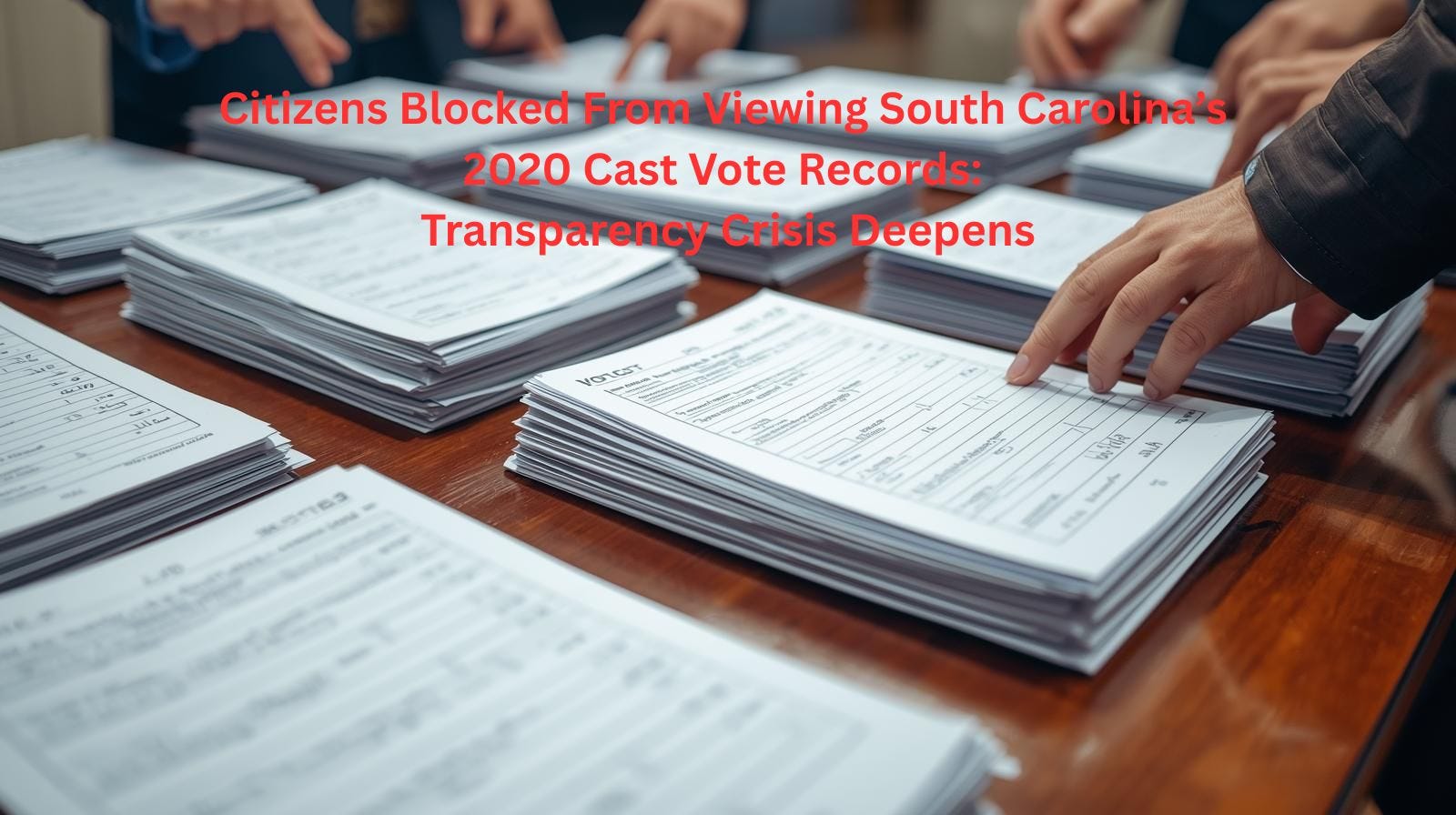
Citizens Blocked From Viewing South Carolina’s 2020 Cast Vote Records: Transparency Crisis Deepens


By Staff Writer

In 2021, a South Carolina citizen submitted a routine Freedom of Information Act (FOIA) request to the South Carolina Election Commission (SCEC) seeking the cast vote records (CVRs) from the 2020 general election.

These digital records created automatically by voting systems reflect how every ballot was counted, line by line. Crucially, they contain no personal identifiers whatsoever. They do not link to voter names, registration numbers, or physical ballots.

Yet the SCEC rejected the request, claiming the records would disclose voter ID and violate ballot secrecy.

https://samueleburns.substack.com/p/citizens-blocked-from-viewing-south

Mexico’s Claudia Sheinbaum Responds to Peter Schweizer’s ‘Invisible Coup,’ Denies Consulates Are Trying to Sway U.S. Elections

Mexican President Claudia Sheinbaum recently addressed allegations made by journalist Peter Schweizer in his book "The Invisible Coup. " Schweizer claims that Mexico is using its consulates in the United States to influence American elections.

• During a press conference, Sheinbaum denied that Mexican consulates engage in any political activities in the U. S. She labeled the allegations as "absolutely false" and emphasized that the consulates' primary role is to provide assistance to Mexican nationals.

• Sheinbaum referred to a recent statement from the Secretary of Foreign Affairs, which also denies the claims made by Schweizer.

• Schweizer argues that the Mexican government is interfering in U. S. politics by mobilizing both legal and illegal migrants to serve its interests. He points to former Mexican President Andrés Manuel López Obrador (AMLO) as actively working against President Donald Trump's immigration policies.

• Sheinbaum attempted to distance Schweizer from the Trump administration, suggesting his claims have no connection to Trump. Despite this, Trump has publicly endorsed Schweizer's book.

• The situation highlights unprecedented direct involvement of a foreign leader in U. S. politics, as described by Schweizer.

Sheinbaum's statements underscore her commitment to non-interference in U. S. affairs, while the discourse raises questions about the influence of foreign governments on American political landscapes. 

https://www.breitbart.com/politics/2026/01/29/mexicos-claudia-sheinbaum-responds-to-peter-schweizers-invisible-coup-denies-consulates-are-trying-to-sway-u-s-elections/

Tulsi Gabbard Releases Documents that PROVE it Was Barack Obama who Led the Russiagate Conspiracy and Coup Against Donald Trump – Documents Have Been Turned Over to the DOJ

 Tulsi Gabbard, the Director of National Intelligence, recently revealed documents that allegedly implicate former President Barack Obama in manipulating intelligence to undermine Donald Trump before he took office. These claims center around the controversial "Russiagate" accusations.

1. Release of Documents: Gabbard shared documents during a White House briefing that reportedly detail Obama's involvement in fabricating allegations that Russia aided Trump's presidential campaign in 2016.

2. Allegations About Russian Collusion: The documents assert that:

• Vladimir Putin preferred Trump to win the 2016 election.

• Russia took steps to assist Trump's campaign.

• There was blackmail material on Trump (referenced as the Steele dossier).

• Russia attempted to communicate with the Trump campaign.

However, Gabbard claims there was no reliable evidence to support these allegations.

3. Criminal Implications: Gabbard has submitted the findings to the Department of Justice (DOJ) for investigation. She emphasized that the evidence suggests Obama was involved in the creation of false intelligence reports aimed at discrediting Trump.

4. Potential Legal Action: During a press conference, Gabbard responded to questions about whether Obama's actions might lead to criminal charges, stating that the DOJ must evaluate this matter concerning Obama.

Tulsi Gabbard's revelations aim to challenge the narrative of Russian interference in the 2016 election, asserting that Obama played a critical role in fabricating false claims against Trump. The information has been referred to the DOJ for further investigation into potential criminal behavior related to these allegations.

https://www.thegatewaypundit.com/2026/01/tulsi-gabbard-releases-documents-that-prove-it-was/

America’s Power Bill Shock Is Just Getting Started

 The latest updates and trends regarding oil prices, energy costs, and geopolitical factors affecting the energy market. It highlights recent changes in prices for various oil types, the impact of rising utility costs on households, and notable events in the energy sector.

Oil Prices Overview

• Current Prices: As of the latest updates:

• WTI Crude: $64.80 (-0.62, -0.95%)

• Brent Crude: $70.15 (-0.56, -0.79%)

• Natural Gas: $3.902 (-0.016, -0.41%)

• Prices for various oil blends and natural energy sources are detailed, indicating minor fluctuations in the market.

• Recent Trends: Increasing costs were noted in some oil types, while others showed slight decreases.

Factors Influencing Energy Costs

• Heating Bills Spike: The National Energy Assistance Directors Association (NEADA) forecasts a 9.2% rise in heating prices for the winter of 2025-2026.

• Electricity Costs: Expected to rise by 12.2%, translating to an increase of about $133 this winter.

• Natural Gas: Projected to increase prices by 8.4%, approximately $54.

• Other Fuels: Heating oil prices are expected to hold steady, while propane is predicted to decrease by 1.4%.

Reasons for Increases

• Economic Factors: Higher interest rates have raised financing costs for power plants and infrastructure. Increasing natural gas prices raise electricity generation costs.

• Growing Demand: Increased electricity demand, partly due to the expansion of data centers, is a contributing factor.

• Infrastructure Challenges: Aging energy grid infrastructure and regional capacity limits increase costs.

• Investment Slowdown: Reduced federal incentives for renewable energy have slowed new investments in clean energy.

Impact on Households

• Financial Strain: Low and moderate-income households are particularly affected, spending a significant portion of their income on energy—about 6% to 10% compared to higher-income households.

• Utility Bills: Approximately one in six households are behind on utility payments, with a collective debt of about $23 billion to gas and electric utilities.

• Disconnection Risks: NEADA estimates that up to 4 million households faced potential disconnections last year, an increase of 500,000 from the previous year.

• Difficult Choices: Families are increasingly forced to choose between paying utility bills and other essentials like food and rent.

Notable Energy Market Events

• Venezuela’s Oil Policy: Venezuela is changing its oil laws to attract foreign investment, demonstrating a shift in its approach to energy trade.

• China’s LNG Imports: China’s liquefied natural gas (LNG) imports have risen for the third consecutive month, indicating changing dynamics in global energy consumption.

• Geopolitical Factors: Current tensions, such as those involving Iran and ongoing sanctions affecting Venezuela, continue to influence global oil supply and pricing.

• Infrastructure Developments: Saudi Aramco has raised significant capital in response to ongoing pressures from oil prices.

Industry Responses

• Utility Rate Changes: Over 210 electric and natural gas utilities have either increased or proposed rate hikes, leading to a projected total increase of around $85.5 billion.

• International Energy Strategies: Countries like Kazakhstan are seeking approvals for investments, and new avenues for LNG supply are opening as nations recalibrate their energy strategies.

The current landscape of oil prices and energy costs shows a clear trend of rising expenses for households, compounded by various economic and geopolitical factors. As energy markets fluctuate, the implications for consumers, especially those with lower incomes, remain significant. As households face increasing bills, policymakers and energy authorities will need to respond to ensure that energy access remains equitable and sustainable.

https://oilprice.com/Energy/Energy-General/Americas-Power-Bill-Shock-Is-Just-Getting-Started.html

America’s Structural Anti-Republicanism

 The perception and portrayal of Republicans and Democrats in the context of civil rights and political conduct in the United States. It argues that there is a cultural bias against Republicans, which influences public opinion and rhetoric.

• Historical Context of Civil Rights: The article reflects on the civil rights movement in the 1960s, highlighting the dangers faced by activists like James Chaney, Mickey Schwerner, and Andy Goodman. It notes the violent opposition they encountered from local groups resistant to federal enforcement of civil rights laws.

• Rhetorical Propaganda: It critiques the narrative that Republicans oppose civil rights while Democrats support them. The article claims that this narrative is a result of historical propaganda and a misunderstanding of past events, including actions taken by Democratic presidents.

• Federal Enforcement and Local Resistance: The author states that cities historically known for resisting Republican presidents often see federal law enforcement agents, such as ICE, facing hostility. The article includes examples of violence against immigrants and law enforcement, attributing such incidents to a broader anti-Republican sentiment in society.

• Hypocrisy of Democratic Leaders: The article highlights instances where Democratic leaders have enacted similar immigration policies that they later criticize when implemented by Republicans. This is presented as a double standard.

• Cultural Incivility: The author describes a “Jacobin culture” that has emerged in the 21st century, characterized by hostility toward Republican figures and the demonization of those in power. This culture reportedly encourages violence against political opponents and undermines civil discourse.

• Historical Violence and Rhetoric: Reference is made to past attempts on the lives of Republican presidents, comparing these to current anti-Republican vitriol. The author argues that the continued portrayal of Republicans in a negative light can lead to real-world violence.

• Call for Rule of Law: The conclusion stresses the importance of maintaining law and order by respecting governmental authority and not allowing localities to spiral into mob rule. It suggests that the historical narrative that vilifies Republican enforcement reflects a greater societal issue that undermines civil rights for all.

The article posits that American society has a structural anti-Republican bias that jeopardizes civil rights and encourages violence against political figures. It calls for a reassessment of historical narratives and greater respect for the rule of law to safeguard civil rights universally.

https://www.americanthinker.com/articles/2026/01/america_s_structural_anti_republicanism.html

Momentum builds in Congress to ban taxpayer funding of Taliban with bill passed in Senate committee

Congress is taking decisive steps to prevent U. S. taxpayer money from reaching the Taliban, a group designated as a terrorist organization by the U. S. government. This follows concerns that funds intended for humanitarian assistance in Afghanistan have inadvertently benefited the Taliban since their takeover in August 2021. Recently, both the House and Senate have made legislative moves to formalize this restriction through the “No Taxpayer Dollars for Terrorists” bill.

1. Senate Committee Action: The Senate Foreign Relations Committee passed the “No Taxpayer Dollars for Terrorists” bill by a party-line vote (12-10), with all Republicans in favor and all Democrats against. This action follows the House's approval of similar legislation.

2. Objectives of the Bill: The bill aims to require the Department of State to create a strategy to discourage foreign assistance and support to the Taliban. It mandates reporting on U. S. funds sent to Afghanistan from the time of the Taliban's takeover until the bill's enactment.

3. Legislative Background:

• The proposal has been championed by various lawmakers, including Sen. Tim Sheehy (R-MT) and Rep. Tim Burchett (R-TN).

• Amendments are included in the bill requiring suspension of foreign assistance to countries or organizations aiding the Taliban.

4. Concerns Over Funding: Reports have indicated that, despite the Taliban's control, the U. S. continued to disburse aid, with substantial funds potentially ending up benefitting the Taliban. The Special Inspector General for Afghan Reconstruction (SIGAR) indicated that U. S. funds have been used to pay taxes to the Taliban-controlled government.

5. International Relations and Terrorism: The Taliban continues to maintain relationships with terrorist organizations, notably al-Qaeda. The organization's presence and the Taliban’s protection of them pose national security threats.

• Reports from the UN monitoring team highlight ongoing Taliban support for terrorist activities in Afghanistan and its unwillingness to fully sever ties with al-Qaeda.

6. Hostage Situations: There are ongoing reports of Americans being held hostage by the Taliban, with specific cases receiving attention. This complicates the issue further as negotiations could indirectly support terrorist funding.

7. Political Dynamics: The bill’s passage reflects partisan divisions in Congress regarding how best to handle foreign relations and aid, especially regarding controversial groups like the Taliban. Republicans advocate for strict measures to prevent taxpayer money from supporting terrorist organizations, while Democrats have expressed concerns over humanitarian impacts.

8. Historical Context: The U. S. had significant military and humanitarian engagement in Afghanistan prior to the Taliban takeover. The transition of power raised alarms regarding the efficacy and oversight of continued aid in a newly hostile governance environment.

The recent movement in Congress to ban taxpayer funding of the Taliban through the “No Taxpayer Dollars for Terrorists” bill indicates a strong bipartisan concern over the implications of U. S. aid in the context of terrorism. As the legislation progresses, it seeks to establish strict oversight over how foreign assistance is allocated, particularly ensuring that taxpayer dollars do not inadvertently benefit a recognized terrorist organization. This action is framed not only as a financial safeguard but also as a response to the broader national security challenges posed by the Taliban's ongoing affiliations with groups like al-Qaeda and the situations of American hostages still in Afghanistan. 

https://justthenews.com/government/congress/momentum-builds-congress-ban-taxpayer-funding-taliban-bill-passage-senate